
Is a Rechargeable Pet Water Fountain Better Than a Plug-In Model?
A rechargeable pet water fountain is better when it lets you put water in a more useful place and you can keep up with charging. A plug-in model is better when a suitable fixed location already has a safe outlet and you want one fewer battery to manage. Neither power system automatically provides cleaner water or a better drinking experience.
Quick answer: Rechargeable pet fountain is useful when it creates a better drinking location and you can sustain charging. Plug-in is simpler when a safe fixed outlet already works. Compare supported flow modes and exact model instructions; neither power type removes water changes, cleaning or daily checks.
On this page
- Power comparison
- WOPET examples
- Choose by location
- Ownership comparison
- Common questions
Start with the pet’s access and your daily routine. Then compare the exact operating modes. A fountain that circulates continuously on a cable may behave differently on its battery.
The practical trade-offs
| Decision | Rechargeable | Plug-in |
|---|---|---|
| Location | Can dispense away from an outlet in supported battery modes. | Needs a suitable powered location and safe cable routing. |
| Routine | Adds charging and battery checks. | Removes recharging, but still needs power and cord checks. |
| Flow | May be sensor-driven or timed on battery. | May support continuous flow; check the exact model. |
| Interruption | A charged battery may keep dispensing during a mains interruption. | Loss of power can stop circulation. |
| Care | Electrical battery components require specified dry care. | Adapter and connections also require dry care. |
When rechargeable is the better fit
A rechargeable model can solve an outlet problem in a quiet cat room, a shared drinking corner or another indoor location where running a cable would be awkward. The benefit is having a good water station where the pet uses it, not simply removing a visible wire.
You still need a safe place to recharge. Before buying, find out whether the charging module separates from the water-contact parts, how low charge is indicated and which modes run from the battery. Keep a second source of fresh water available during charging.
Do not compare battery capacities as if they were runtime scores. Two devices with the same mAh rating can have different motors, dispensing durations, sensors and operating patterns. Record your actual recharge interval after normal use.
When plug-in is simpler
A fixed fountain beside a suitable outlet can be straightforward: fill, clean and check normal flow without remembering a separate recharge task. It may suit someone who values continuous operation, provided that exact model supports the intended setting.
Position the adapter and connections away from splashes and protect the cord from chewing or tripping. A cable is a routing job, not a reason to put the fountain in an inconvenient place. If the only available outlet produces a poor drinking location, reconsider the layout.
Compare like with like: the two 3L ceramic modelsW03: 3L cordless ceramic
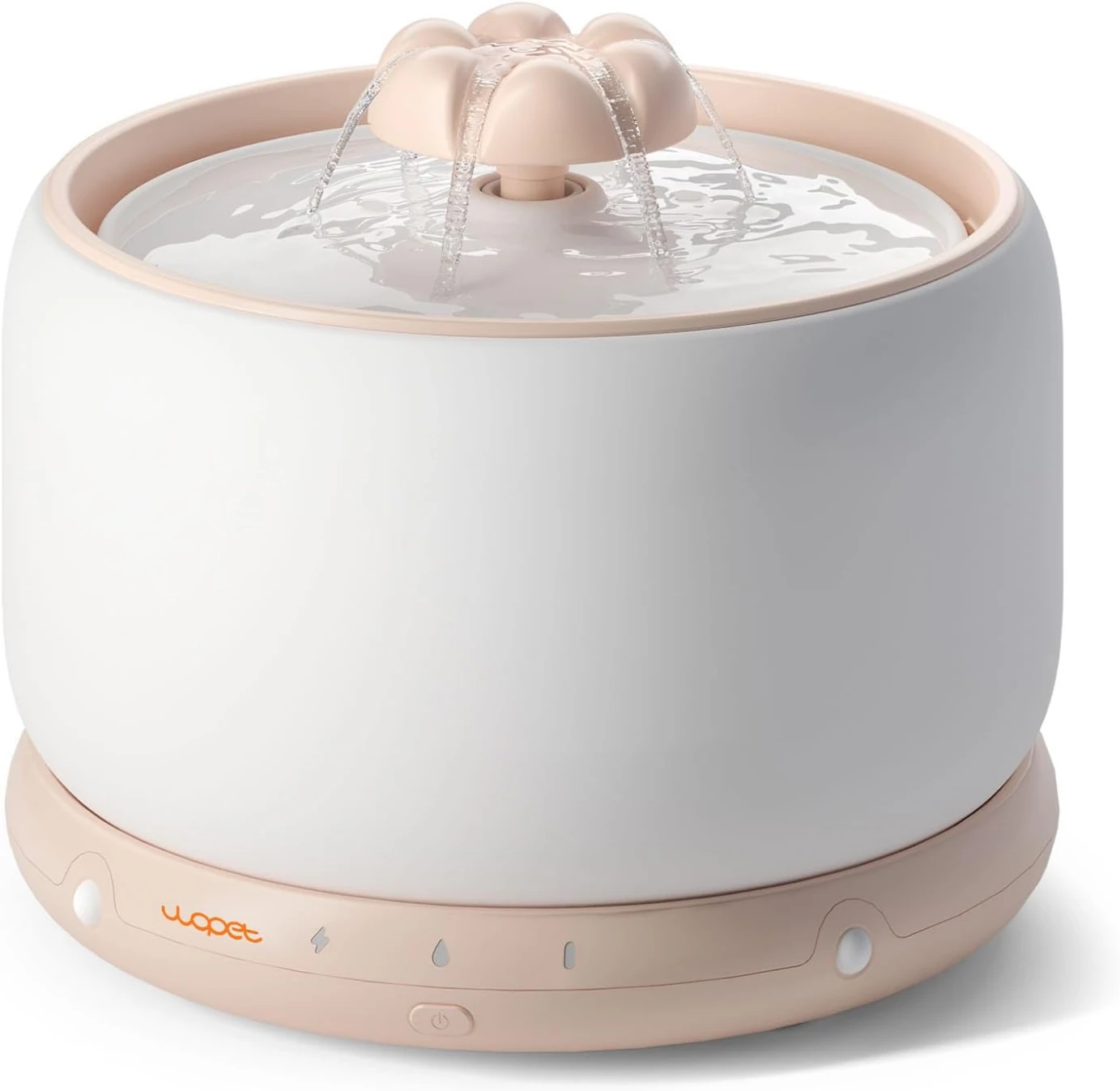
WOPET W03 · 3L · Rechargeable / cordless
The W03 has a rechargeable pet fountain base and ceramic body. It is the option to compare when you want that material but the best drinking spot is away from the outlet. The base and bowl need their own care instructions, so separate electrical and washable parts correctly.
W03L: 3L wired ceramic
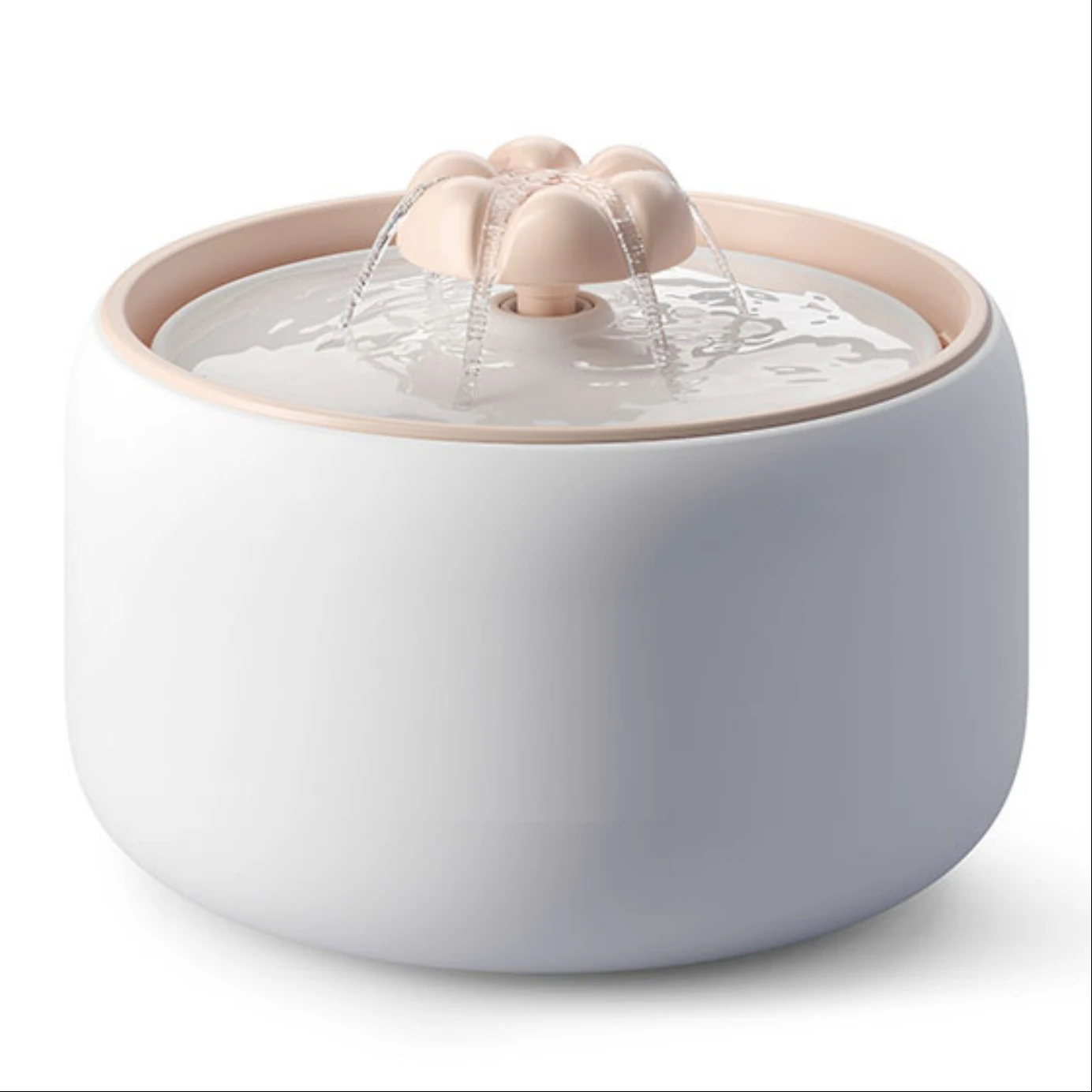
WOPET W03L · 3L · Plug-in
The W03L pet fountain is the plug-in counterpart in this comparison. It also holds 3L; the L does not mean a 6L tank. It suits a fixed ceramic station when the outlet location works and avoiding recharging is a priority.
When the decision includes a larger tankW600 Pro: 6L rechargeable
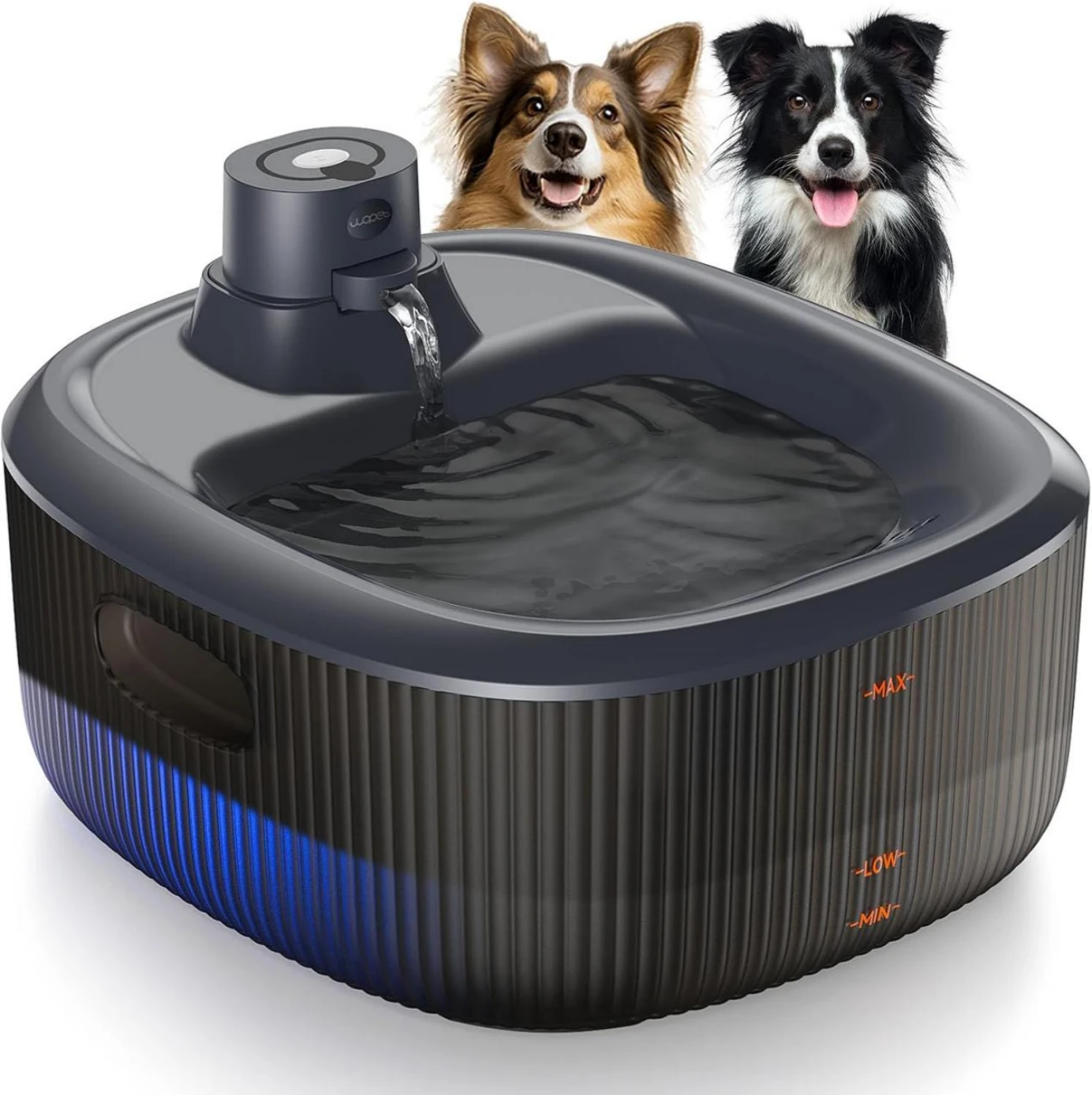
WOPET W600 Pro · 6L · Rechargeable / cordless
The W600 Pro pet fountain is the larger rechargeable WOPET example here, intended for dogs or multi-cat use. Compare its floor space, drinking area and lifting job as well as its battery. It should not be treated as a direct material-only comparison with the smaller ceramic W03L.
Check the mode your pet will actually use
Read the manual for sensor range, dispensing duration and timer behaviour where provided. Watch the pet approach and drink. A cautious cat may hesitate when a stream starts; a dog may need enough comfortable drinking time. Follow supported settings rather than modifying the device.
The power connection also matters when comparing other brands. For example, PETLIBRO’s battery-operated Dockstream distinguishes battery sensor operation from plug-in continuous flow. That illustrates why cordless placement and constant circulation should be checked separately.
Water care is the same decision either way
Inspect the water, level and normal operation daily. Wash the parts according to their instructions and replace the exact compatible filter. A battery can still be full when the water needs changing, and a powered pump can still circulate through a dirty tray.
Avoid selecting a power system as a way to stretch pet-care visits. Neither one substitutes for checking the animal and the station.
Choose by the job you need done
Choose rechargeable when a better location justifies charging. Choose plug-in when the fixed location is good and you prefer a simpler power routine. If both fit, compare how the fountain opens, where filters are sold and whether the drinking surface suits your pet. Those details will matter long after the novelty of the device wears off.
Use a location-first decision process
Start by placing a clean bowl in the location you think would work best, while keeping the existing source available. Watch whether the pet uses that area comfortably. If the location itself is poor, a battery will not fix the crowded approach, noisy appliance or awkward escape route.
If the location works, check the power route. A fixed outlet may make plug-in practical without trailing a lead through a walkway. If no suitable outlet is nearby, a rechargeable design may preserve the better location. The decision should follow access rather than the other way around.
Then verify the flow behaviour you need. Write down whether you want continuous movement, sensor dispensing or timer operation. Check which of those settings work on battery for the exact product. “Rechargeable” describes a power source; it does not define the outlet’s behaviour.
What a sustainable charging routine looks like
Identify the part that charges and how it separates from washable components. Read the adapter requirement and low-charge indication in the manual. Keep the charging connection dry and choose a place where wet parts will not be set down beside it.
During the first normal cycles, note recharge dates and the selected mode. Reassess if more pets begin using the station or activation frequency changes. A reminder based on your own household is more useful than copying another owner’s longest interval.
Provide a separate source of fresh water while charging or cleaning. This keeps the process calm: there is no reason to reconnect wet parts quickly because the pet has no other source. If a module is damaged or behaves unexpectedly, contact support rather than opening a sealed battery compartment.
What a dependable plug-in routine looks like
Keep the adapter and connectors positioned according to the manual and protected from splashes. Inspect the cord during cleaning and prevent pets from chewing it. Do not hide a damaged cable or compensate for a poor location with a risky improvised route.
Check actual flow, not simply whether an indicator is lit. A powered unit still needs adequate water, correct assembly and clean serviceable parts. An outlet connection does not mean the water path is free of debris or that the tank has been washed.
Plan an alternative water source for maintenance and interruptions. The lack of a charging task simplifies one part of care, but it does not remove the need to see the pet and station each day. Choose simplicity in the complete routine, not just in how power reaches the device.
Compare ownership rather than only the purchase price
| Cost or task | What to check |
|---|---|
| Filters | Exact compatibility, replacement schedule and local availability. |
| Charging equipment | What is included and what the manual specifies. |
| Battery support | Warranty and supported service options for the exact model. |
| Cleaning time | Removal steps, tank handling and dry electrical storage. |
| Future help | Model-specific manuals and available service parts. |
A battery problem and a filter replacement are different support questions. Keep the receipt and exact model details so you can ask for the right assistance. Do not assume the W03 and W03L share every component because their ceramic bodies look similar, or that W600 Plus instructions apply to W600 Pro.
Common questions
Which ceramic WOPET model is rechargeable?
W03 is the 3L cordless ceramic model with a rechargeable base. W03L is also 3L but wired. Choose according to location, flow requirements and care routine rather than interpreting the model letters as a difference in capacity.
Is plug-in cheaper to own?
It may avoid a battery-related service issue, but total ownership depends on purchase price, compatible filters, parts and care. Compare the exact products rather than assuming one power category always costs less. Avoid price calculations without current local prices and the relevant operating conditions.
Does rechargeable mean safer around water?
Both designs must be used and maintained according to their electrical and water-care instructions. A battery removes a permanent wall connection during supported cordless use, but electrical modules still require proper handling. Do not treat a power category as a guarantee against every hazard.





-
Is a Rechargeable Pet Water Fountain Better Than a Plug-In Model?
A rechargeable pet water fountain is better when it lets you put ... -
-
-
-
-
-


